Three Hosts, Five Wins: USA, Mexico and Canada Rewrite World Cup History
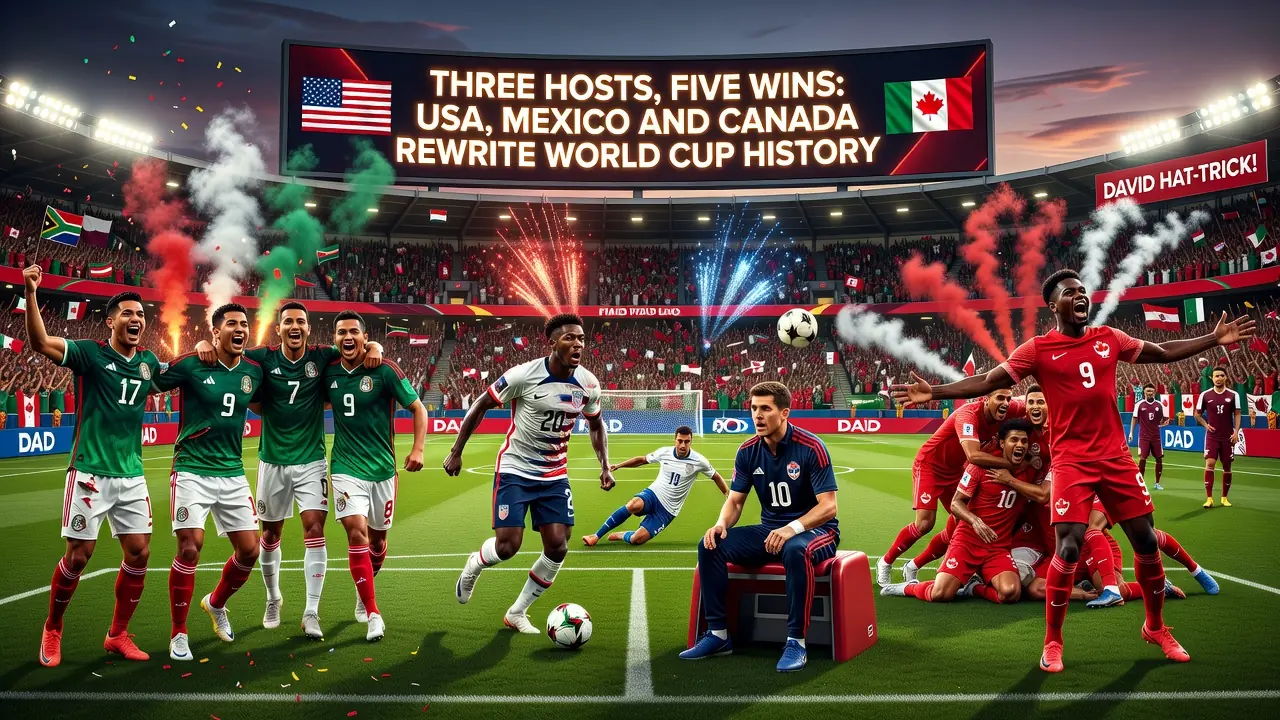
For the first time since the tournament expanded to 48 teams, three co-hosts are sharing a World Cup stage - and all three have arrived with genuine purpose. After two matchdays, the United States, Mexico, and Canada have collectively won five of their six group games, with Mexico and the United States already through to the Round of 32 and Canada sitting top of Group B. The narrative entering the tournament was cautious optimism at best. What has unfolded has been considerably more compelling.
The historical weight behind this moment is worth understanding. Hosting a FIFA World Cup carries obligations far beyond the logistical and financial - billions spent on stadiums, infrastructure, and facilities - but the reward in footballing terms has historically been substantial. Home advantage delivered five trophies across the first eleven editions of the tournament, with Uruguay, Italy, England, West Germany, and Argentina all lifting the cup on home soil. Yet that era feels distant now. France's 1998 triumph remains the only time a host nation has won the World Cup in the past four decades, and since then, no host has even reached the final. Among those who fell earliest, South Africa in 2010 and Qatar in 2022 stand as the only hosts to have been eliminated at the group stage - a distinction that focused minds considerably as this tournament approached. The contrast with the fast-paced, high-engagement world of sports consumption today is stark; even niche disciplines like betting on live futsal have built global audiences in the time it has taken football's host-nation advantage to erode so dramatically. betting on live futsal
Mexico were the most expected to lead the charge, and they have done precisely that. A 2-0 victory over South Africa, followed by a 1-0 win against South Korea, made El Tri the first side to confirm their place in the knockout rounds of this expanded competition. Their defensive structure has been a foundation worth noting, and goals from Julián Quiñones, Raúl Jiménez, and Luis Romo have provided variety in attack. For a team that crashed out in the group stage in Qatar two years ago, this represents a meaningful restoration of credibility. Mexico's best World Cup performances - quarterfinalist finishes in 1970 and 1986, both as hosts - have not been bettered in any tournament since. The signs suggest that record may finally come under serious pressure.
The United States Emerge as the Most Forceful Hosts
If Mexico have met expectations, the United States have exceeded them. Mauricio Pochettino's side dismantled Paraguay 4-1 before following with a composed 2-0 victory over Australia, sealing their place in the knockout stage without Christian Pulisic, who missed the second match through injury. The absence of their most recognisable player did not disrupt them. Folarin Balogun, who netted twice against Paraguay, has provided a clinical edge up front, and the Americans have benefited from an own goal in each game - a detail that speaks as much to their pressing and forward pressure as to good fortune. When the United States last hosted the World Cup in 1994, they reached the Round of 16. Their all-time best remains a third-place finish in the inaugural 1930 edition. Both benchmarks now appear within reach.
Canada Make History With Every Match They Play
Canada's contribution to this tournament may be the most emotionally resonant of all three hosts. A nation that had never previously won a World Cup match - losing all three games in 1986 and all three in 2022 - earned their first-ever point with a 1-1 draw against Bosnia and Herzegovina. Then came the 6-0 demolition of Qatar, a result that shattered several records simultaneously. It is the largest margin of victory ever achieved by a CONCACAF nation at a World Cup. Striker Jonathan David's hat-trick made him the first player from outside Europe and South America to score three goals in a single World Cup match. Canada now sit top of Group B with four points and a goal difference that commands attention.
What the Hosts' Form Means for the Tournament Ahead
The broader context matters here. In the modern era, the psychological and logistical advantages of hosting - home crowds, familiar conditions, no long-distance travel - have not reliably translated into deep runs. The increasing globalisation of football has narrowed the gap between host nations and traditional powers. Yet what the United States, Canada, and Mexico have demonstrated in the opening phase is that collective momentum is real, and that home support in three distinct footballing cultures - across stadiums in the US, Canada, and Mexico - creates a genuinely unique atmosphere. Whether any of the three can push into the latter stages of the tournament and challenge the established elite remains to be seen. What is already clear is that they have moved the conversation from participation to competition. That alone marks a shift. The weeks ahead will determine how far it goes.