Toronto's World Cup Watch Party Shut Down Early After Fireworks Disrupt Argentina Celebrations
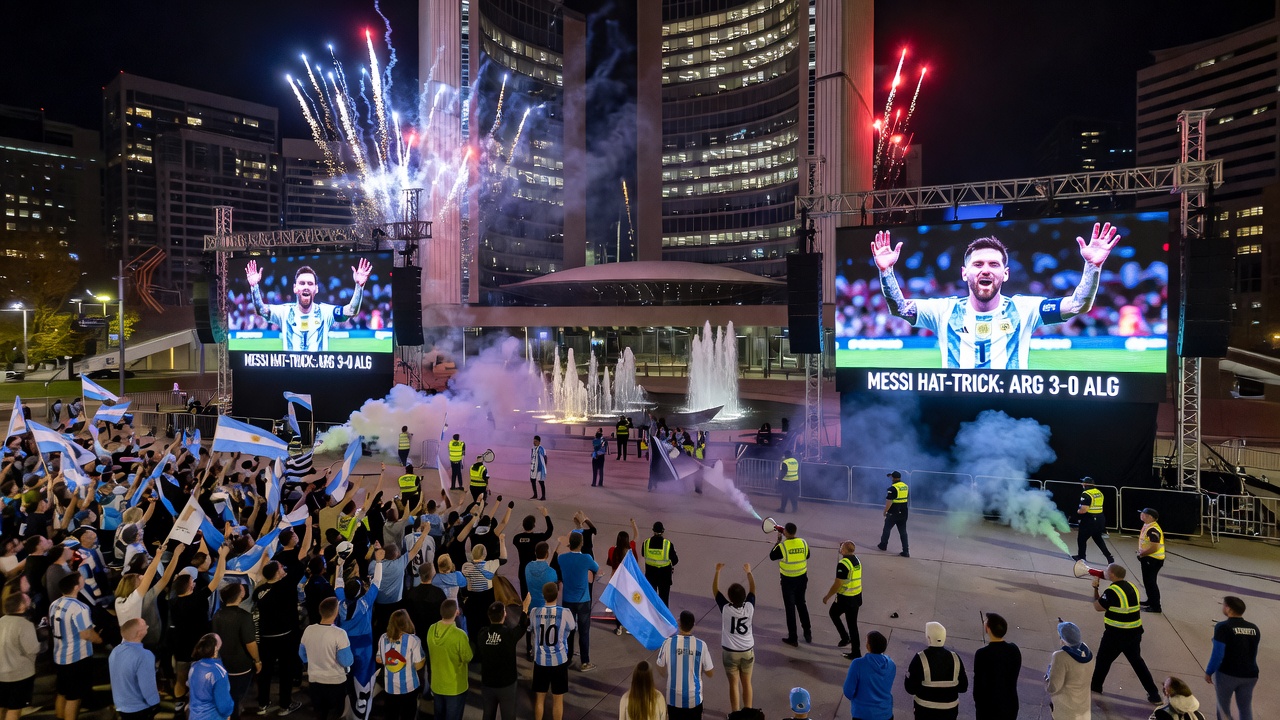
Toronto's free public viewing party at Nathan Phillips Square was brought to a premature end on Tuesday night after fans set off fireworks and smoke flares during Argentina's dominant 3-0 group-stage victory over Algeria. Organizers cited public safety concerns as the reason for cutting the event short, turning off the screens and making a public announcement shortly after Lionel Messi completed his hat-trick in Kansas City. The intervention marks an early test for a host city that will stage five World Cup matches across the tournament.
The city-organized watch parties, held in the open square outside Toronto City Hall, are free to enter and draw large, mixed crowds of football supporters. Attendees are not subject to security screening before entering the venue, a logistical reality that presents obvious challenges when crowd behavior escalates. Sharon Bollenbach, Executive Director of Toronto's FIFA Secretariat, confirmed the decision in a statement to The Athletic: "On-site staff ended the Nathan Phillips Square viewing party earlier than scheduled on June 16 due to a public safety concern. The City of Toronto will continue to prioritize the safety of our attendees, staff and volunteers during our events." It is worth noting that while football and other major sports dominate World Cup-era attention, events like these sit at the crossroads of sport and public management - much like the logistical debates that have touched everything from stadium capacity to padel betting odds, where governing bodies and organizers increasingly wrestle with audience growth outpacing infrastructure.
Police and security personnel were present in the area, but the open-access nature of the event left organizers with limited tools to prevent items like fireworks and smoke flares from being brought in. When asked directly whether attendees were subject to any security screening before entering, organizers did not respond. That silence will likely fuel questions in the coming days about how the city plans to manage similar events as the tournament progresses and crowds grow.
Messi's Hat-Trick Ignites the Crowd - and the Problems
The context of what was happening on the pitch matters here. Argentina entered the tournament as defending World Cup champions, and Messi, now in what is widely understood to be the final chapter of his international career, delivered a performance entirely befitting his stature - completing a hat-trick to put his side firmly in control of the group. For Argentine supporters watching in Toronto, the night was one of pure celebration, and the emotional charge that comes with watching a generational talent perform on the biggest stage clearly drove some fans toward behavior that crossed a line. The fireworks and flares, whatever the intent behind them, created an environment that on-site staff judged to be unsafe for the broader crowd.
A Host City's Responsibility Beyond Match Days
Toronto is one of 16 host cities spread across the United States, Canada and Mexico for this edition of the World Cup, and the logistical weight of that role extends well beyond the stadium. The city's next hosted fixture is Germany against Ivory Coast on Saturday, and the events of Tuesday night will sharpen the focus on how Nathan Phillips Square watch parties are managed going forward. Mayor Olivia Chow was present at the start of the evening to greet attendees but had departed before the situation required intervention.
The challenge facing Toronto is not unique. Major tournaments around the world have consistently struggled with the gap between the scale of public viewing events and the security infrastructure supporting them. Free, open-air screenings attract enormous numbers precisely because of their accessibility - but that same openness creates vulnerabilities. How the city responds in the coming days, whether by introducing screening measures, restricting certain items, or adjusting the format of future events, will say much about its readiness to manage a World Cup host city role that carries both tremendous opportunity and real responsibility.