Scheffler Turns 30 at Shinnecock Hunting the Grand Slam's Final Piece
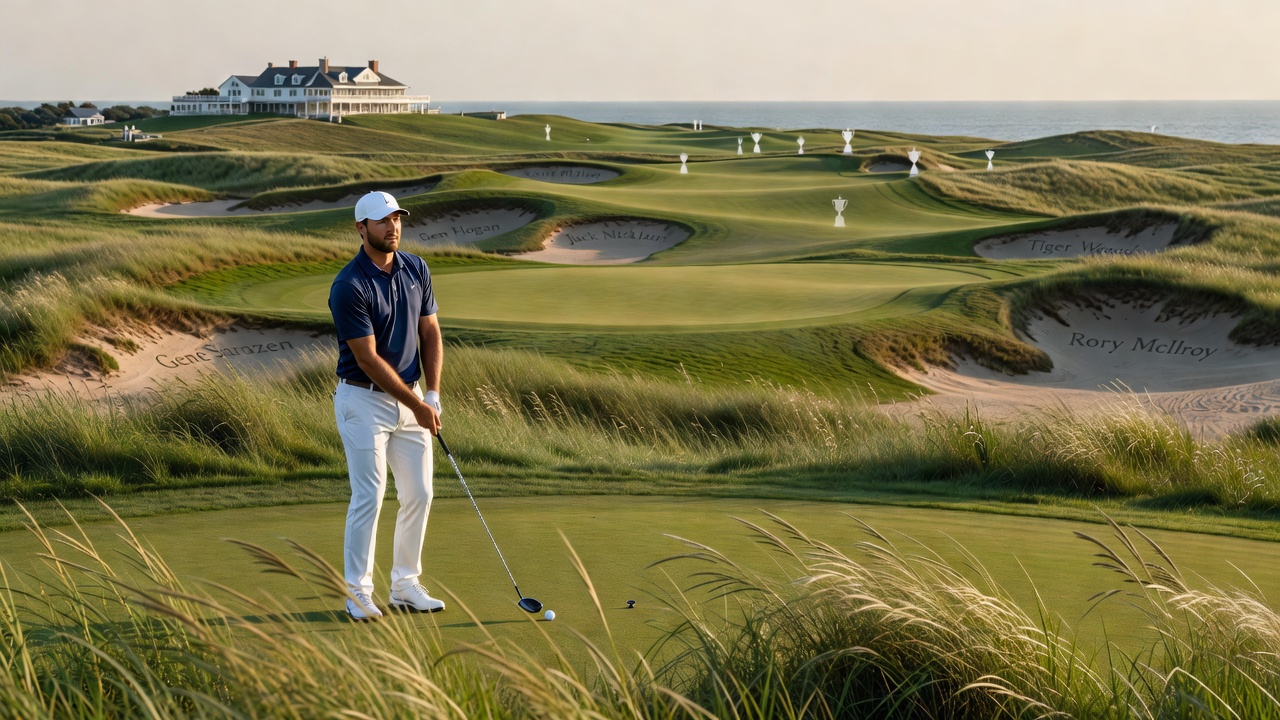
Most golfers spend a career chasing one major. Scottie Scheffler spent his twenties winning four of them. On Sunday, he turns 30 at Shinnecock Hills with a single item left on his wish list: the U.S. Open title, and with it, the career Grand Slam. The occasion is as clean as sport gets - the world's best player, the game's most punishing major, and the one trophy that has refused to cooperate.
The U.S. Open is not in the business of handing out gifts, and Shinnecock Hills is its most unforgiving accomplice. The windswept Long Island links has hosted four U.S. Opens over the last four decades, and only three players have finished the tournament under par across all of them. When it last played host in 2018, Brooks Koepka won at one over. That kind of scoring context shapes how markets read the field well in advance, much like ante-post betting does in other sports - where early positioning reflects reputation and projected conditions rather than live form. Scheffler carries a 14% implied win probability on prediction market Kalshi and an 18.4% implied win probability on DraftKings Sportsbook, a gap that reflects both the house margin and the premium the book places on his dominance. ante-post betting
The chaos embedded in this tournament's recent history complicates any tidy narrative. Aaron Rai arrived at last month's PGA Championship as a 175-to-1 afterthought and left carrying the Wanamaker Trophy. J.J. Spaun defied 125-to-1 odds to win the 2025 U.S. Open - the second time in three years the tournament produced a winner at 100-to-1 or longer. Shinnecock amplifies that volatility. Its rough is punishing, its winds are unforgiving, and par is less a baseline than a daily achievement. Former USGA chairman Sandy Tatum captured the philosophy precisely: "We're not trying to humiliate the best players in the world; we're simply trying to identify who they are."
The Form Case for Scheffler
Scheffler has not won a tournament since January, but the underlying numbers are not flashing concern. He leads the field in datagolf's true strokes gained and strokes gained tee-to-green metrics for the season. That form has surfaced consistently on the scorecard: a top-three finish in roughly half his starts this year, including four of his last six events. He arrives at Shinnecock as a course rookie under U.S. Open conditions, but his major record offers its own credibility - seventh, third, and runner-up finishes in three of the four previous U.S. Opens. The only missing outcome is the one that matters most this week.
The Challengers and Their Complications
Rory McIlroy sits second on the odds board with a 6.8% implied win probability, and his U.S. Open record justifies the position - top-10 finishes in six of his last seven appearances. The complication is Shinnecock itself: McIlroy missed the cut the last time he played there. On FanDuel Sportsbook, he is listed ahead of Jon Rahm and Xander Schauffele, but all three share identical odds to make the cut, which suggests the separation between them on the winner market is driven by upside potential rather than any meaningful edge in reliability.
Brooks Koepka had the most compelling return-to-Shinnecock argument - a champion coming back to the scene of his title, with the course knowledge that most of the field simply does not have. A hand injury that forced his withdrawal from last week's RBC Canadian Open has introduced real uncertainty around that bid. Shinnecock's rough demands full commitment through the ball, and any hesitation in the hands changes the arithmetic entirely.
What Sunday Actually Means
The Grand Slam - all four major titles - has been completed by only six players in the history of professional golf. The list reads like a monument: Gene Sarazen, Ben Hogan, Gary Player, Jack Nicklaus, Tiger Woods, and Rory McIlroy. Scheffler holds the Masters, the PGA Championship, and The Open Championship. The U.S. Open is the one wall that has not come down. If it falls on Sunday, it falls on his birthday, at one of the most difficult venues in major championship history, in a field deep enough to embarrass any favorite.
Scheffler's short odds are not a concession to narrative. They reflect the distance between him and the rest of the field in nearly every meaningful performance metric this season. Shinnecock will make it hard. The course always does. But the books, the markets, and the numbers are all saying the same thing: if anyone can turn a brutal examination into a birthday present, it is the man who has spent the last decade making majors look routine.